




Air Conditioning Repair in Hurst — Not Just Breakdowns
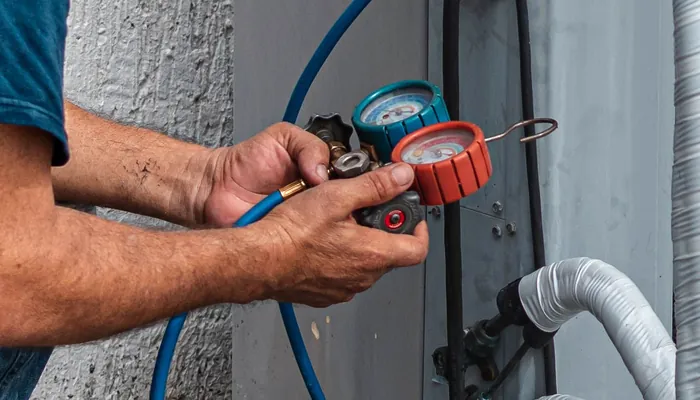
Not every call for air conditioning repair in Hurst, TX is a breakdown. A system that is cooling but costing too much, a unit that has never had a service since it was installed, a filter nobody can reach, or a new owner who simply wants to know what they have inherited. That is still air conditioning repair in Hurst — it is just the cheaper end of it, and it is the conversation most companies skip because there is less money in it.
If you are ringing round HVAC in Hurst, TX — the AC companies Hurst homeowners keep recommending to each other — trying to work out who is worth calling, here is a fair test: ask each one what their diagnostic fee is and whether it comes off the repair. Anyone who will not answer that on the phone is not going to get clearer once a technician is standing in your hallway.
Is There a Service Call Fee — and Does It Go Toward the Repair?
Yes. A diagnostic visit in the Hurst area runs $75 to $200. That covers a technician coming out and finding the actual fault, not a guess. If you approve the repair, that fee is credited toward the total — so you’re not paying twice.
Most HVAC companies charge double or triple after hours. If a call takes place outside normal hours, you’ll be told the rate on the phone, before anyone is dispatched. No surprise number on the invoice.
What’s the Most Common AC Repair in Hurst Homes?
A failed capacitor is the single most common AC repair. It’s a small part that gives the fan and compressor the jolt they need to start. Texas heat kills them. Second most common is a refrigerant leak, third is a clogged condensate drain. Most of these are same-day fixes.
The pattern is worth knowing, because it tells you something useful: the most common AC failure is also one of the cheapest. If your unit is humming but not starting, there’s a good chance you’re looking at a $150–$450 repair, not a new system. Anyone who jumps straight to “you need a replacement” without testing the capacitor first is skipping a step.
Your AC Isn’t Broken at 104 Degrees — Here’s the 20-Degree Rule
A standard residential air conditioner can only pull the indoor temperature about 20 degrees below the outdoor temperature. That’s a physical limit, not a defect.
So on a July afternoon in Hurst when it’s 104 outside, your system can realistically hold the house around 78 to 84 degrees. If your thermostat is set to 72 and the room reads 79, your AC is working correctly. Setting it to 68 won’t cool the house faster — it just makes the compressor run non-stop without ever hitting the target, which raises your bill and wears out the equipment.
When it actually is a problem: if the gap between outdoor and indoor temperature is much less than 20 degrees — say it’s 100 outside and your house is sitting at 88 — then something is genuinely wrong. That’s a real service call.
- Set the thermostat to 78 and let it hold. Raising it 7 to 10 degrees while you’re at work can cut around 10% off your yearly cooling cost
- Close blinds on the west and south windows before the afternoon
- Skip the oven and the dryer between 3pm and 8pm
- Run ceiling fans only in rooms you’re actually in
If you called someone out on a 104-degree day and they replaced parts without first checking whether your system was simply at its physical limit, you paid for a repair you didn’t need.
Repair or Replace? The $5,000 Rule in Plain English
When a repair quote gets big, there’s a simple piece of math the industry uses. Multiply your system’s age by the repair quote. If the result is over $5,000, replacement is usually the better financial decision.
| Your system | Repair quote | Math | What it says |
|---|---|---|---|
| 6 years old | $400 | 6 × 400 = $2,400 | Repair it |
| 12 years old | $500 | 12 × 500 = $6,000 | Lean replacement |
| 15 years old | $1,400 | 15 × 1,400 = $21,000 | Replace |
| 20 years old | $250 | 20 × 250 = $5,000 | Borderline — a cheap part can buy you a season |
There’s a second version of the same idea: if a repair costs more than half the price of a new system, put the money toward the new system instead.
R-22. If your system is 16+ years old it likely runs R-22, which is no longer produced. Any refrigerant work on it is expensive and gets worse every year. This pushes hard toward replacement.
You’re moving soon. If you’re selling within a year or two, a $300 fix on an old unit is often the right call even when the formula says replace.
Your warranty. Compressors and coils often carry 10-year parts warranties. Before you accept a $2,500 compressor quote, the model and serial number need to be checked against the manufacturer’s registration. That check can turn a huge bill into a labour-only bill.
We’ll run this math with you out loud. If a repair isn’t worth your money, we’ll say so — and if a repair is the smarter move, we’ll say that too, even when a replacement would pay us more.
Brands We Work On in Hurst — and What Actually Breaks on Them
Goodman · Amana. Very common in DFW and one of the easier systems to own. Parts are stocked locally, so repairs are quick and cheap. Capacitors and control boards are the usual failures.
Trane · American Standard. Same manufacturer, same internals. Built tough, long-lived. The known repair is a spine-fin coil leak — labour-heavy but a real repair, not automatically a replacement.
Carrier · Bryant · Payne. Same family. Basic models are straightforward. The higher-end variable-speed systems use proprietary communicating boards that cost more and take longer to source.
Lennox. Excellent efficiency, but parts are proprietary. A Lennox-specific board or blower motor can cost noticeably more and occasionally means a wait. Worth knowing before you accept a quote.
Rheem · Ruud. Same manufacturer. Solid, widely serviced. Capacitors and contactors are the routine wear items.
York · Coleman · Luxaire. Same family. Control board failures are the common complaint and parts availability can lag during peak summer. If you’ve got one of these and it’s over 12 years old, factor that in.
Heil · Tempstar · Arcoaire · Day & Night. Budget lines from the same maker. Blower motors and boards are the usual repairs.
Whoever you use for HVAC repair in Hurst, the honest version is this: installation quality matters more than the badge on the box. A premium system installed with the wrong refrigerant charge or undersized ductwork will fail sooner than a budget system installed correctly. If your unit isn’t on this list, it can almost certainly still be serviced.
Why Hurst Housing Changes the Job
A lot of Hurst was built between the 1950s and the 1980s, when Bell Helicopter’s plant brought families in. That means a large share of homes have original or near-original ductwork, undersized return air, and equipment mounted in the attic. Three practical consequences:
- Upstairs rooms run hot even when the AC is healthy — that’s usually a duct problem, not an AC problem
- Duct leaks in a 130-degree attic dump your cold air into the attic instead of your bedroom
- Systems installed before 2010 likely run R-22, which changes the repair-vs-replace math
A technician who knows Hurst housing checks the ductwork and the attic before recommending a new condenser.
Licensed Work, Honest Answers
Every job in Hurst is quoted in writing before it begins and backed by a workmanship warranty, with manufacturer coverage on parts. Every technician we work with is licensed, insured, background-checked and ID-verified before they step through your door.
We explain what we found in plain language, show you the readings if you want to see them, and never start work you haven’t approved.
What This Usually Looks Like: No Cool Air Upstairs
A two-storey home off Precinct Line Road had no cool air upstairs during a 103-degree week. Another company had quoted a full system replacement. The actual faults were a collapsed flex duct in the attic and a failed capacitor — repaired the same afternoon, for a fraction of the replacement quote. Composite example based on how this fault typically presents — not a specific customer job.