AC Maintenance & Tune-Up in Hurst, TX
You pay around a hundred dollars, a technician spends forty minutes at your house, and you have no way of knowing what was actually done. So here is the full checklist before you book — including which items matter and which are padding.
- Fully Insured
- 24/7 Emergency Service
- Workmanship Warranty
- Upfront Pricing
- Serving Tarrant County
Get Your Free Quote
We’ll get back to you as soon as possible. No spam, ever.
What Does AC Maintenance Cost in Hurst, TX?
HVAC maintenance in Hurst runs $89 to $200 for a single system tune-up, and $150 to $350 for two systems. Annual plans sit between $15 and $25 a month. The full checklist is published below, before you book.
Prices vary by system, parts, and unit age. We confirm your exact price before any work begins.
What Does AC Maintenance Cost in Hurst, TX?
HVAC maintenance in Hurst, TX runs $89 to $200 for a single system tune-up, and $150 to $350 if you have two systems. Annual plans in this market sit between $15 and $25 a month. Below is the actual checklist a proper visit covers — and an honest note on which items matter and which are padding.
The Problem With Buying a “Tune-Up”
You pay somewhere around a hundred dollars. A technician spends forty minutes at your house. You get told everything looks fine, or you get told something needs replacing. Either way you have no way of knowing what was actually done.
That is the real objection to maintenance, and it is a fair one. So here is the checklist, published before you book rather than after, with the honest version of what each item is worth.
What Is Actually Included in an AC Tune-Up?
| Check | Why it matters | Honest value |
|---|---|---|
| Capacitor tested with a meter | The most common failure on any system. A capacitor reading below rating is weeks from failing | The single most valuable item on the list |
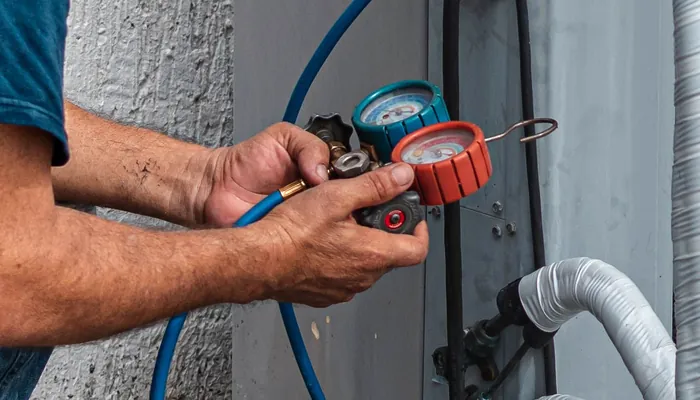
| Refrigerant pressures | Low charge means a leak, and a system running low for years kills its own compressor | High |
| Condenser coil cleaned | Cottonwood seed and grass mat onto the fins. A choked coil cannot dump heat | High — especially late spring |
| Condensate drain cleared and flushed | A blockage above a finished ceiling is a $75 fix that becomes a several-thousand-dollar repair | High on attic installs |
| Temperature split measured | 16–22°F between return and supply. Anything else points at a fault before you feel it | High |
| Electrical connections tightened | Vibration loosens terminals; a loose connection arcs and burns out a contactor | Moderate |
| Contactor inspected | Pitted contacts are visible and predictable | Moderate |
| Blower wheel and motor amp draw | A motor pulling above spec is failing slowly | Moderate |
| Filter changed | Genuinely important — but you can do this yourself for $10 | Low as a paid item |
| Thermostat calibration | Rarely the problem on a modern digital thermostat | Low |
| Coil “treatments” and sanitising sprays | Sold as an add-on | Usually padding |
Read that top row again. A tested capacitor is most of the value of the entire visit. It is the part most likely to fail, it fails in July, and it is the difference between a $150 planned repair and a $450 emergency one at 11pm. If a maintenance visit does not include a meter reading on the capacitor, it is not a tune-up — it is a look.
Does HVAC Maintenance Actually Extend System Life?
Yes, and in this climate the difference is measurable rather than theoretical.
An air conditioner in North Texas lasts 12 to 18 years. Where a system lands in that range is decided by a small number of things: whether the coil stayed clean, whether it ran low on refrigerant for years, and whether it had the airflow it needed. All three are maintenance items.
The mechanism is simple. Every one of those faults makes the compressor work harder, and compressor failure is what ends a system’s life. A serviced system is not magically immune — it just does not spend five years quietly straining. We go through the full picture in our guide to how long an AC unit lasts in Texas.
When Should I Schedule It?
| Season | When | Why then |
|---|---|---|
| Cooling | March–April | Before the first 95°F week. A weak capacitor found in March is a scheduled repair; found in July it is an emergency call |
| Heating | September–October | Before the first freeze. A furnace sits unused eight months and fails silently — you want to find that on a mild afternoon |
The timing is the whole point. Both peak seasons produce the same pattern across the Mid-Cities: thousands of systems asked to work hard on the same day, every accumulated fault surfacing at once, and every technician in Tarrant County booked. Maintenance is not really about the checklist. It is about finding the fault on a day when you still have a choice.
If your furnace has not run since March, our guide to why a furnace blows cold air explains what fails over an idle summer and what it costs.
Are Maintenance Plans Worth It?
Sometimes. Here is the arithmetic rather than the sales pitch.
A typical plan in this market costs $15 to $25 a month — call it $180 to $300 a year — and usually includes two visits, priority scheduling, a waived or reduced diagnostic fee, and a discount on repairs.
Two visits bought separately run $180 to $400. So on the visits alone a plan is roughly break-even. The value is not the visits. It is the priority scheduling. On the first 105°F day, plan holders get seen first. That is worth real money on the day it matters and nothing at all on any other day.
- Worth it if: your system is over eight years old, you have two or more systems, you are a landlord, or you cannot afford to be without cooling for two days in July.
- Probably not if: your system is under five years old and still under warranty, and you are comfortable booking a single tune-up each spring yourself.
Ask three questions: what exactly is included in each visit, does the plan auto-renew, and what happens to the money if you sell the house. A plan that will not answer those in writing is selling convenience, not maintenance.
What Can I Do Myself Between Visits?
More than most companies will tell you. None of this needs a technician:
- Change the filter every 30 to 60 days in summer. Closer to 30 with pets. This is the cheapest thing that extends system life, and skipping it causes more breakdowns than any other single habit.
- Keep a foot of clear space around the outdoor unit. Trim shrubs back.
- Rinse the condenser fins gently with a hose, from the inside out, in late spring when the cottonwood seed drops. Never a pressure washer — it flattens the fins permanently.
- Pour a cup of distilled vinegar down the condensate drain access twice a summer to keep the line clear.
- Leave the thermostat fan on AUTO. ON runs the blower constantly and makes a healthy system feel broken.
Older Systems Need It More, Not Less
There is a common instinct to stop servicing a system once it gets old, on the grounds that it is going to need replacing anyway. It is backwards.
An older system is exactly where a $150 capacitor found in spring saves a $450 emergency call in July — and where knowing about a small refrigerant leak matters most, because if the system runs R-22 refrigerant that leak is the difference between a repair and a replacement decision.
This matters more in some parts of the area than others. The post-war housing in Haltom City and the 1970s–90s stock in Watauga hold the oldest equipment we see, and it is where a spring check pays for itself most reliably. The Smithfield side of North Richland Hills is similar. Newer building in Keller, Grapevine and Southlake is often still inside a manufacturer parts warranty — which is its own reason to keep the service record intact, because lapsed maintenance is a documented reason warranty claims get refused.
Two Systems Means Two Tune-Ups
A lot of larger homes in Keller and Southlake run two or three complete systems — and each one needs its own capacitor test, its own coil clean and its own drain flush. A quote for “a tune-up” on a three-system house is either mispriced or only covering one unit. Ask which.
Where We Work
Maintenance across Hurst (76053, 76054), Bedford (76021, 76022), Euless (76039, 76040), North Richland Hills (76180, 76182), Haltom City (76117), Watauga (76148), Keller (76248), Grapevine (76051), Southlake (76092) and Colleyville (76034).
If something is already wrong rather than due a check, the full repair price table is on the Hurst page, and 24/7 emergency cover runs year round.
Licensed Work, Honest Answers
You get the readings, not just a verdict. Capacitor microfarads against rating, refrigerant pressures, temperature split, blower amp draw — written down, so next year’s numbers mean something. Every technician is licensed, insured, background-checked and ID-verified.
And if the visit finds nothing wrong, we will tell you that plainly rather than inventing a reason to come back.
How Service Works
Three easy steps — no runaround, no surprise pricing.
Call or Fill Out the Form
Tell us your system type, what it’s doing (or not doing), and your area or ZIP code.
Get an Upfront Quote First
We diagnose the real problem and give you a flat, written price before any work starts — so you decide, not us.
We Fix It — Often Same Day
A background-checked technician arrives, gets it running, and cleans up. Most repairs are done in one visit.
AC Maintenance & Tune-Up in Hurst, TX FAQs
What is actually included in an AC tune-up?
Does maintenance really extend system life?
When should I schedule it?
Are maintenance plans worth it?
What can I do myself between visits?
My system is old — is maintenance still worth it?
Explore Our Services
Areas We Serve



Ready to Get Comfortable Again?
Skip the form — the fastest way to get help is a phone call. Tell us what your system is doing and we’ll give you a straight answer and an upfront price.
(817) 710-3410Need AC Maintenance & Tune-Up in Hurst, TX in Hurst?
Real techs, real answers, upfront pricing — 24 hours a day.
📞 Call (817) 710-3410